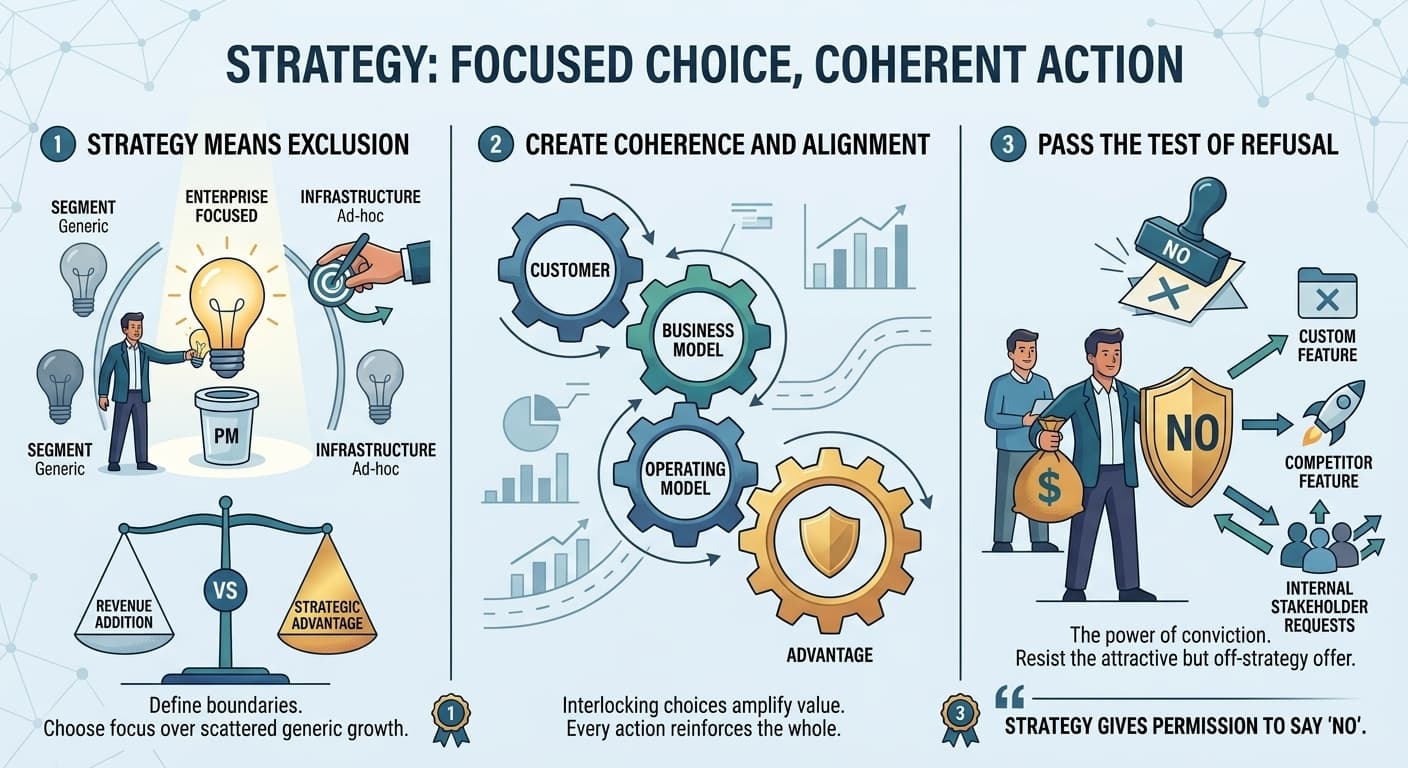
A strategy that makes every sensible idea look compatible is not really helping you choose.
01 Bad ideas are easy to reject
Nobody needs much strategy to reject an obviously poor idea.
The real test comes when two ideas are both genuinely good.
One could unlock a new enterprise segment.
Another could materially improve activation.
A third could solve an infrastructure weakness customers rarely see.
All three may create value.
You still cannot do all three now.
That is where strategy begins.
02 Strategy needs exclusion
Teams often describe strategy as a statement of ambition:
We will become the leading platform for X.
We will provide delightful customer experiences.
We will grow internationally.
None of those statements tells a team what not to do on Monday morning.
A useful strategy creates boundaries.
It says:
For this period, this customer matters more.
This problem deserves more attention.
This capability is more important than that adjacent opportunity.
This business model is the one we are optimising.
The moment those choices become real, some attractive ideas begin to feel wrong.
That is not a flaw.
It is evidence that the strategy has teeth.
03 “Good” is not a sufficient prioritisation criterion
Teams often kill obviously weak ideas and then assume the remaining backlog can be ranked objectively.
It cannot.
The hard questions are relative.
Is this good idea more aligned with where we have decided to win than that good idea?
Does this opportunity strengthen our advantage or simply add revenue?
Does this customer segment reinforce the operating model we want or drag us into another one?
A roadmap full of individually sensible initiatives can still be strategically incoherent.
Strategy earns its value when it gives you permission to say no to something attractive.
04 The uncomfortable test
I like asking teams:
What would we refuse even if a large customer asked for it?
The question usually creates discomfort.
Good.
Now we are talking about strategy.
If every sufficiently large request can redirect the roadmap, commercial pressure is the strategy.
If every competitor feature becomes urgent, competitive anxiety is the strategy.
If every internal stakeholder gets one priority, political equilibrium is the strategy.
None of those should be confused with product strategy.
Before approving a major initiative, finish the sentence:
“This is consistent with our strategy because…”
If the answer could equally justify ten unrelated ideas, the strategy is not specific enough.
05 Coherence matters more than activity
Strong product organisations do not just make many good decisions.
Their decisions reinforce each other.
The customer they choose influences the capabilities they build.
The capabilities influence the business model.
The business model influences the operating model.
The operating model influences where they invest.
That coherence is what eventually becomes an advantage.
Good strategy therefore creates an odd feeling.
You will occasionally look at a genuinely good opportunity and say:
That is a good idea. It is just not our idea right now.
That sentence is strategy doing its job.
Responses
Responses are reviewed before they appear.