You do not need to become an engineer. But the ability to make an idea tangible changes the quality of the conversation.
01 Something changes when the idea becomes visible
There is a huge difference between saying:
“Imagine the merchant can configure approvals here.”
and showing a working flow where the merchant actually does it.
The second conversation becomes more specific almost immediately.
Engineering asks about state.
Design notices an interaction problem.
Operations asks what happens when approval expires.
Someone spots an edge case.
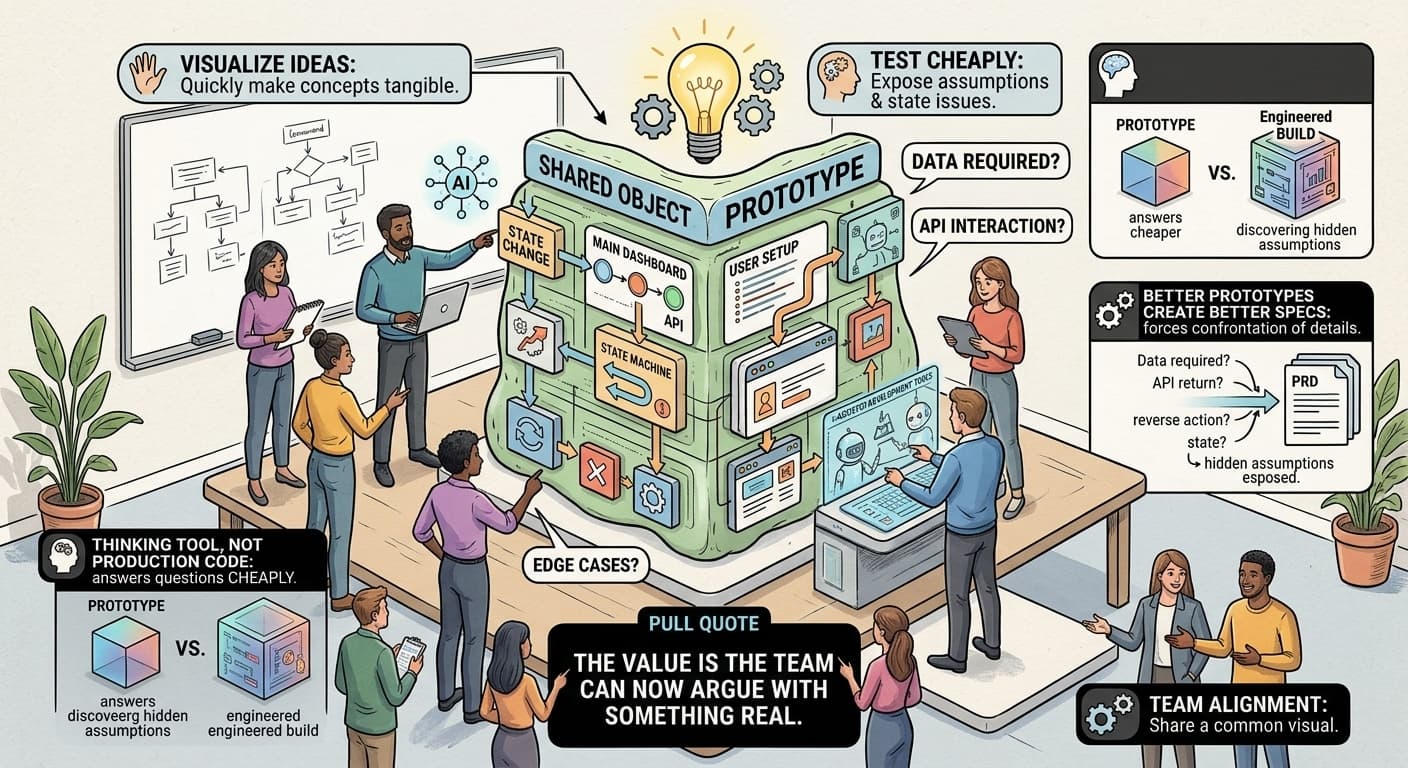
The prototype becomes a shared object people can disagree with.
That is valuable.
02 AI has lowered the cost of making ideas tangible
Product managers have always used wireframes and prototypes.
What has changed is how far a non-engineer can now go.
With modern AI-assisted development tools, a PM can increasingly turn an idea into:
a clickable experience,
a rough internal tool,
an API interaction,
a simulated workflow,
or even a functioning proof of concept.
This does not remove Engineering.
It makes earlier conversations better.
03 The goal is not production code
This distinction matters.
A prototype is not a sneaky attempt to ship code around Engineering.
It is a thinking tool.
Its job is to answer questions cheaply.
Can the workflow make sense?
Where does state become complicated?
What assumptions are hidden?
How many steps does the customer actually need?
What does the error experience look like?
A PM who prototypes is often discovering product complexity before asking an engineering team to absorb it.
The value of the prototype is not that you built it. It is that the team can now argue with something real.
04 Better prototypes create better specifications
I have found that building even a rough version forces you to confront details that disappear inside a PRD.
What happens after the user clicks this?
What data is required?
What if the API returns nothing?
Can the user reverse the action?
What state does the page return to?
Those questions improve the eventual specification.
05 The relationship with Engineering should get stronger, not weaker
The wrong posture is:
“Look, I built it. It should be easy.”
The better posture is:
“I built enough to understand the experience and expose some assumptions. Now help me understand what this actually means technically.”
That changes the conversation.
You arrive with more empathy for implementation.
Engineering spends less time translating ambiguity.
And both sides can focus on the difficult part:
building the right thing properly.
Responses
Responses are reviewed before they appear.