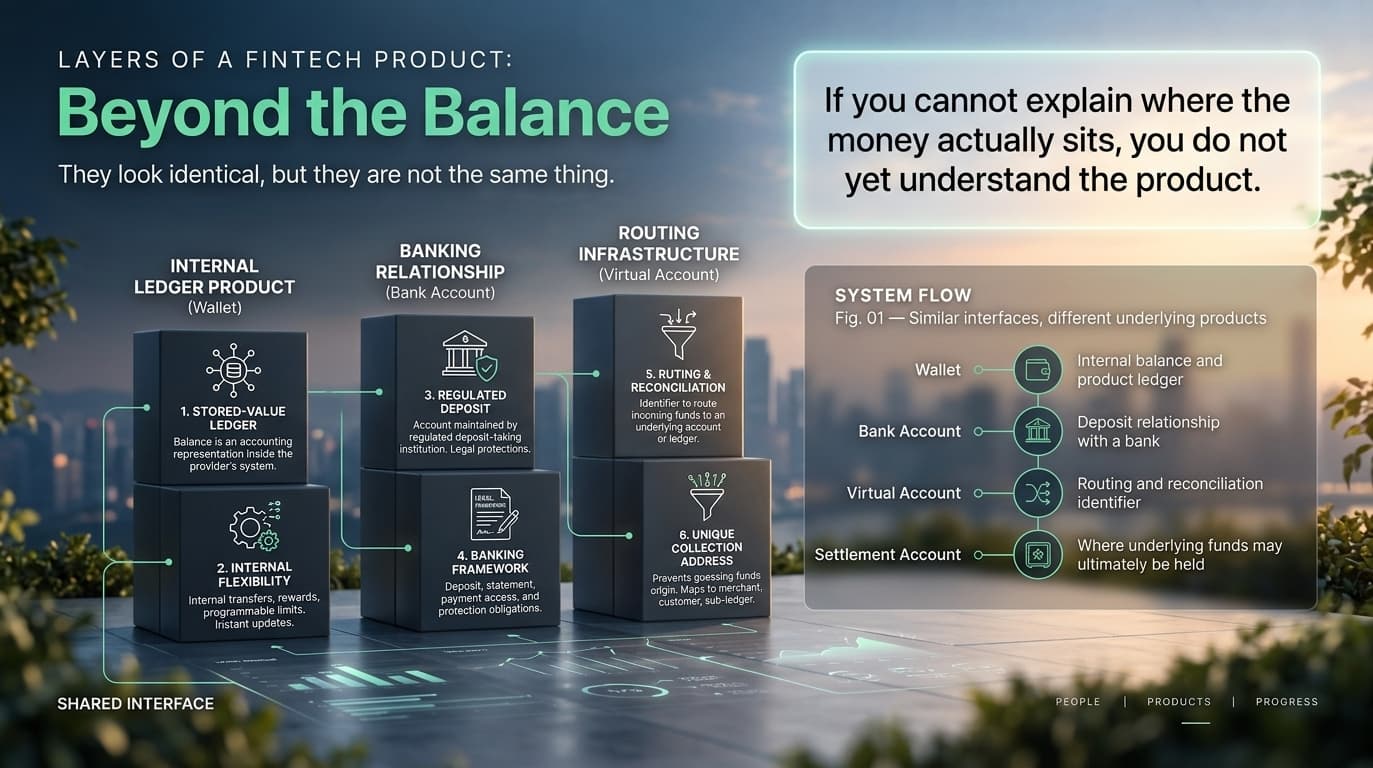
They can all show a balance and accept money. That does not make them the same thing.
01 The interface creates the confusion
To a customer, the products can look almost identical.
There is an account number.
Money arrives.
A balance changes.
Money can sometimes be sent out.
That visual similarity hides very different infrastructure underneath.
A wallet is primarily a stored-value or ledger relationship inside a provider’s system.
A bank account is an account maintained by a regulated deposit-taking institution under the banking framework applicable to that jurisdiction.
A virtual account is usually an address or account identifier created to route incoming funds to an underlying account or ledger.
They solve different problems.
02 A wallet is fundamentally a ledger product
When a wallet says you have ₦50,000, £500 or $200, the critical question is:
Where does that balance legally and operationally exist?
In many wallet products, your balance is represented in an internal ledger.
The provider may hold corresponding safeguarded or settlement funds elsewhere, depending on its licence and structure.
But the customer-facing wallet balance is an accounting representation inside the provider’s system.
That is why wallets can be extremely flexible.
They can support internal transfers, rewards, programmable limits or instant balance updates without every movement necessarily being a bank-to-bank transaction.
03 A bank account is a banking relationship
A bank account is different.
The bank is maintaining an account for the customer within its regulated banking infrastructure.
That brings different obligations around deposits, statements, payment access, safeguarding or deposit protection depending on the jurisdiction and account type.
The distinction matters when a fintech says:
“Open an account.”
Is the customer opening an actual bank account?
Or a wallet that looks like one?
Those are not interchangeable claims.
04 A virtual account is usually routing infrastructure
A virtual account often looks most like a bank account because it can have an account number.
But the number may not represent a standalone deposit account at all.
It can instead be a unique collection address mapped to:
a merchant,
a customer,
an invoice,
a wallet,
or a sub-ledger.
The value is reconciliation.
Instead of receiving thousands of transfers into one bank account and guessing who paid, each customer receives a unique virtual account number.
When funds arrive, the platform already knows who they belong to.
Wallet → Internal balance and product ledger
Bank Account → Deposit relationship with a bank
Virtual Account → Routing and reconciliation identifier
Settlement Account → Where underlying funds may ultimately be held
05 Product managers need to know which layer they are designing
These distinctions affect:
who legally holds customer money,
what happens during insolvency,
how reconciliation works,
what licences are required,
how transfers settle,
what the customer should be told,
and what happens when systems disagree.
Calling everything an “account” makes interfaces simpler.
It can also make product thinking dangerously imprecise.
The UI may look identical.
The legal relationship, money movement and failure modes are not.
If you cannot explain where the money actually sits, you do not yet understand the product.
Responses
Responses are reviewed before they appear.